Ten Commandments
4the10.net
 |
| Ten Commandments |
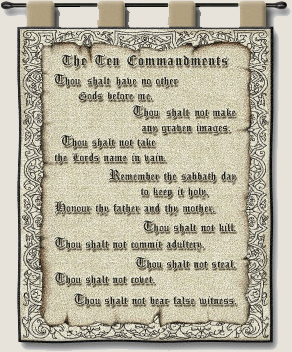
The Ten Commandments Information Bible Study Web Site. List of the Commandments, crafts, Christian activities. These are eternal gospel principles that are necessary for our exaltation. The Lord revealed them to Moses in ancient times (see Exodus 20:1-17), and they are also referenced in whole or in part in other books of scripture see Matthew 19:18-19, Romans 13:9;. The Ten Commandments are a vital part of the gospel.
Like Us:

Ten Commandments New Testament
For us in the New Testament, most of the Ten Commandments list things we should not do, they also represent things we should do. The Savior summarized the New Testament Ten Commandments in two principles - love for the Lord and love for our fellow men:
-
"Thou shalt love the Lord thy God with all thy heart, and with all thy soul, and with all thy mind."
"This is the first and great commandment."
"And the second is like unto it, Thou shalt love thy neighbor as thyself" Matthew 22:37-39.
Ten Commandments and of Moses
Moses was born during the Hebrew enslavement in Egypt, during a terrible period when Pharaoh decrees that all male Hebrew infants are to be drowned at birth. His mother, Yocheved, desperate to prolong his life, floats him in a basket in the Nile. Hearing the crying child as she walks by, Pharaoh's daughter pities the crying infant and adopts him (Exodus 2:1-10). It surely is no coincidence that the future liberator of Israel is raised as an Egyptian prince. Which further prepared him for leadership.
The Torah records only three incidents in Moses' life before God appoints him a prophet. As a young man, outraged at seeing an Egyptian overseer beating a Hebrew slave, he kills the overseer. The next day, he tries to make peace between two Hebrews who are fighting, but the aggressor takes umbrage and says: "Do you mean to kill me as you killed the Egyptian?" Moses immediately understands that he is in danger, for though his high status undoubtedly would protect him from punishment for the murder of a mere overseer, the fact that he killed the man for carrying out his duties to Pharaoh would brand him a rebel against the king. Indeed, Pharaoh orders Moses killed, and he flees to Midian. At this point, Moses probably wants nothing more than a peaceful interlude, but immediately he finds himself in another fight. The seven daughters of the Midianite priest Reuel (also called Jethro) are being abused by the Midianite male shepherds, and Moses rises to their defense (Exodus 2:11-22). God used Moses to deliver the Children of Israel.
Does it matter whether we obey Jesus and Ten Commandments today?
Wouldn't it be wonderful if we could ask Jesus Christ if keeping the Ten Commandments today is still necessary?
Actually, today that is not as difficult as it may seem. That question was directly put to Jesus, and the Bible preserves His reply for us. "Now behold, one came and said to Him, 'Good Teacher, what good thing shall I do that I may have eternal life?' So He said to him, 'Why do you call Me good? No one is good but One, that is, God. But if you want to enter into life, keep the commandments'" (Matthew 19:16-17). That is about as clear as one can be.
Jesus said that He expects any who desire to receive the gift of eternal life to also keep God's Biblical Law today.
The person then asked exactly which commandments Jesus meant. Did He have the Biblical Law in mind, or was He referring to the many extra biblical dictates taught by other religious leaders? Jesus left no doubt. When asked which ones, Jesus responded: "You shall not murder," "You shall not commit adultery," "You shall not steal," "You shall not bear false witness," "Honor your father and your mother," and "You shall love your neighbor as yourself" (verses 18-19). He briefly recited half of the Ten Commandments. He then quoted another command, from Leviticus 19:18, that summarizes the intent of the moral law and confirms the validity of the rest of the law. He was clearly referring to the law of God, not to the restrictions added by certain other religious leaders (Matthew 15:1-3).
Many people have heard that Jesus abolished the Old Testament laws. Here again Jesus gives us His own direct response:
"Do not think that I have come to abolish the Law or the Prophets; I have not come to abolish them but to fulfill them. I tell you the truth, until heaven and earth disappear, not the smallest letter, not the least stroke of a pen, will by any means disappear from the Law until everything is accomplished. Anyone who breaks one of the least of these commandments and teaches others to do the same will be called least in the kingdom of heaven, but whoever practices and teaches these commands will be called great in the kingdom of heaven" (Matthew 5:17-19).
Again, Jesus spoke clearly and to the point. God's law has not been abolished, and, according to Christ's own words, anyone who teaches so is directly contradicting Him and is in serious spiritual trouble.
Michael Horton Kline
Many assume they do not need to keep God's law because Christ "fulfilled" it. But these people fundamentally misunderstand Christ's clear words. The word translated fulfill in this passage means "to make full, to fill to the full" (Vine's Complete Expository Dictionary of Old and New Testament Words, "Fill"), and that is exactly what Jesus did. He perfectly kept the Ten Commandments and completely filled their meaning. He showed their spiritual intent, explaining that unjustified anger equates with murder (verses 21-22), and lust is mental and emotional adultery (verses 27-28). Jesus expanded the intent of the Biblical Ten Commandments.
For more Biblical Ten Commandments information from the Bible:
Read from the Biblical law of Deuteronomy of the Bible. Biblical Ten Commandments Biblical law, do
they have any meaning today and should we strive to obey the law today? Very Biblical.
Deuteronomy 5
1 And Moses called all Israel, and said unto them, Hear, O Israel, the statutes and judgments which I speak in your ears this day, that ye may learn them, and keep, and do them.
2 The LORD our God made a covenant with us in Horeb.
3 The LORD made not this covenant with our fathers, but with us, even us, who are all of us here alive this day.
4 The LORD talked with you face to face in the mount out of the midst of the fire,
5 (I stood between the LORD and you at that time, to show you the word of the LORD: for ye were afraid by reason of the fire, and went not up into the mount;) saying,
6I am the LORD thy God, which brought thee out of the land of Egypt, from the house of bondage.
Ten Commandments of Moses bring you these Bible Verses
1 Kings 2:40-4240 So Shimei arose, saddled his donkey, and went to Achish at Gath to seek his slaves. And Shimei went and brought his slaves from Gath.
41 And Solomon was told that Shimei had gone from Jerusalem to Gath and had come back.
42 Then the king sent and called for Shimei, and said to him, “Did I not make you swear by the Lord, and warn you, saying, ‘Know for certain that on the day you go out and travel anywhere, you shall surely die’? And you said to me, ‘The word I have heard is good.’
What Does the Bible Teach the Christian about Life Insurance?
Why Should a Christian buy Life Insurance?